顯示具有 LTE 標籤的文章。 顯示所有文章

2023年3月8日 星期三

"LTE Positioning Protocol (LPP)" elaborated by ChatGPT

 LTE (Long-Term Evolution) Positioning Protocol is a protocol used to determine the location of a mobile device within a cellular network. The protocol provides location information by using various measurements taken by the mobile device and the network.

Here are some of the location information that LTE Positioning Protocol carries:

  1. Time Difference of Arrival (TDOA): This measurement is used to calculate the distance between the mobile device and multiple base stations. The time difference between the arrival of the signal at different base stations is used to calculate the location of the mobile device.

  2. Observed Time Difference of Arrival (OTDOA): This measurement is similar to TDOA but uses the time difference between the mobile device and the base station instead of between multiple base stations.

  3. Cell Global Identity (CGI): This is a unique identifier for each cell in a cellular network. The CGI can be used to identify the cell where the mobile device is located.

  4. Reference Signal Received Power (RSRP): This measurement is the received signal power from the base station. The strength of the signal can be used to estimate the distance between the mobile device and the base station.

  5. Reference Signal Received Quality (RSRQ): This measurement is the quality of the received signal from the base station. The quality of the signal can be used to estimate the distance between the mobile device and the base station.

  6. Serving Cell Identifier (SCID): This is a unique identifier for the cell where the mobile device is currently connected.

  7. Cell ID: This is a unique identifier for the cell where the mobile device is currently located.

  8. Global Navigation Satellite System (GNSS) Information: This information includes the latitude, longitude, and altitude of the mobile device, which is obtained from GPS or other satellite-based navigation systems.

Overall, LTE Positioning Protocol combines various measurements to provide accurate location information of the mobile device within the cellular network.

2022年7月3日 星期日

Reselection, Redirection 與Handover的區別

 Source https://blog.csdn.net/yxy8576/article/details/79224554

1.重選(Idle->Idle)

Reselection是UE在非連接態(Idle)下的行為。UE根據SIB消息中配置的各種與重選相關的參數,確定什麼時間開始進行同頻、異頻或者異RAT的測量。當滿足重選準則後,UE啟動重選流程,重選後UE仍處於Idle態。

2.重定向(已連接->空閒)

Redirection是UE在連接態(Connected)下的行為。重定向分為兩種,一是盲重定向,eNodeB根據事先配置的目標頻點要求UE進行重定,有一定的失敗概率;另一種是基於測量的重定向,UE發送測量報告給eNodeB,然後eNodeB在Redirection請求中會包含要求UE重定向去的頻點信息。重定向後UE處於Idle態。

3. 切換(已連接->已連接)

Handover是UE在連接態(Connected)下的行為。Handover是基於測量的,與重定向的區別在於如果源eNodeB和目標eNodeB之間存在X2接口的情況下,eNodeB會啟動Handover流程,否則就啟動Redirection流程。


2019年11月19日 星期二

LTE Numbering & Addressing

Source: https://www.tutorialspoint.com/lte/lte_numbering_addressing.htm#:~:targetText=Each%20tracking%20area%20has%20two,Tracking%20Area%20Identity%20(TAI).

An LTE network area is divided into three different types of geographical areas explained below:
S.N.Area and Description
1
The MME pool areas
This is an area through which the mobile can move without a change of serving MME. Every MME pool area is controlled by one or more MMEs on the network.
2
The S-GW service areas
This is an area served by one or more serving gateways S-GW, through which the mobile can move without a change of serving gateway.
3
The Tracking areas
The MME pool areas and the S-GW service areas are both made from smaller, non-overlapping units known as tracking areas (TAs). They are similar to the location and routing areas from UMTS and GSM and will be used to track the locations of mobiles that are on standby mode.
Thus an LTE network will comprise of many MME pool areas, many S-GW service areas and lots of tracking areas.

The Network IDs

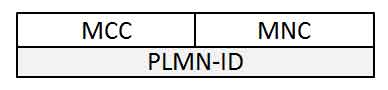
The network itself will be identified using Public Land Mobile Network Identity (PLMN-ID) which will have a three digit mobile country code (MCC) and a two or three digit mobile network code (MNC). For example, the Mobile Country Code for the UK is 234, while Vodafone's UK network uses a Mobile Network Code of 15.
LTE Network ID

The MME IDs

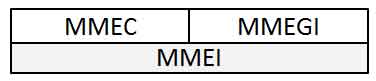
Each MME has three main identities. An MME code (MMEC) uniquely identifies the MME within all the pool areas. A group of MMEs is assigned an MME Group Identity (MMEGI) which works along with MMEC to make MME identifier (MMEI). A MMEI uniquely identifies the MME within a particular network.
LTE MMEI
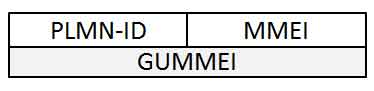
If we combile PLMN-ID with the MMEI then we arrive at a Globally Unique MME Identifier (GUMMEI), which identifies an MME anywhere in the world:
LTE GUMMEI

The Tracking Area IDs

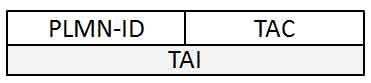
Each tracking area has two main identities. The tracking area code (TAC) identifies a tracking area within a particular network and if we combining this with the PLMN-ID then we arrive at a Globally Unique Tracking Area Identity (TAI).
LTE TAI

The Cell IDs

Each cell in the network has three types of identity. The E-UTRAN cell identity (ECI) identifies a cell within a particular network, while the E-UTRAN cell global identifier (ECGI) identifies a cell anywhere in the world.
The physical cell identity, which is a number from 0 to 503 and it distinguishes a cell from its immediate neighbours.

The Mobile Equipment ID

The international mobile equipment identity (IMEI) is a unique identity for the mobile equipment and the International Mobile Subscriber Identity (IMSI) is a unique identity for the UICC and the USIM.
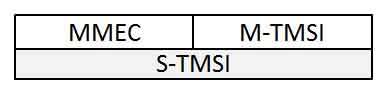
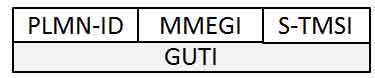
The M temporary mobile subscriber identity (M-TMSI) identifies a mobile to its serving MME. Adding the MME code in M-TMSI results in a S temporary mobile subscriber identity (S-TMSI), which identifies the mobile within an MME pool area.
LTE S-TMSI
Finally adding the MME group identity and the PLMN identity with S-TMSI results in the Globally Unique Temporary Identity (GUTI).
LTE GUTI


LTE to clarify

# of cells are supported in 1 BS (BSS + BST + BSC) ?
# of bands are supported in cell ?

LTE procedures overview

Source: https://www.sharetechnote.com/ > LTE

01. UE is Off
02. Power On UE
04. Timing Sync
     Time and Frame Synchronization : In this process, PSS and SSS will be decoded as well.
             PCI (Physical Cell ID) is derived (a.k.a PCI detection)
05. Cell Search : Normally a UE would find multiple cells in this process 
07. MIB decoding
      UE can figure out System Bandwidth and Transmission Mode in this process. 
      (As you see in Downlink Framestructure, MIB/PBCH is located at the 6 RBs around the 
      center frequency. So the success of MIB decoding does not guarantee that signal quality
      across the whole band is good)
      Detect CSR (Cell Specific Reference Signal) and perform Channel Estimation and 
      Equalization. In this process, UE will detect/measure reference signal across the whole
      system bandwidth. So RSRP/RSRQ measured at this step can be a good indicator for 
      overall signal quality.
      Decode PDCCH and extract DCI information for SIB. PDCCH is spread across the whole 
      bandwidth, so the signal quality across the whole bandwidth should be good enough 
      for this step.
08. SIB deconding (SIB1 should be decoded first and then SIB2 and then remaining SIBs)
      Cell Selection: UE tries camp on to HPLM cell with the highest priority.
10. Registration/Authentication/Attach
11. Default EPS Bearer Setup
      11.A Now UE is in IDLE Mode
      11.B (If the current cell become weak or UE moves to another cell regisn) Cell Reselection
12. (When Paging message comes or User make a call) RACH Process
13. Setup Dedicated EPS Bearer
      13.A Receive data
      13.B Transmit data
              (Full duplex is possible for FDD bands)
      13.C (If UE power is percieved too weak by the network)
              Network send TPC command to increase UE Tx Power
             (If UE power is percieved too strong by the network)
              Network send TPC command to decrease UE Tx Power
14. (If UE moves to another cell region) Network and UE perform Handover procedure
15. User stop call and UE gets into IDLE mode

2016年9月26日 星期一

URLs for WWAN

UE (User Equipment) Category                                http://niviuk.free.fr/ue_category.php

LTE ShareTechnote         http://www.sharetechnote.com/html/Handbook_LTE_PUCCH_Format.html